Workshop Overview
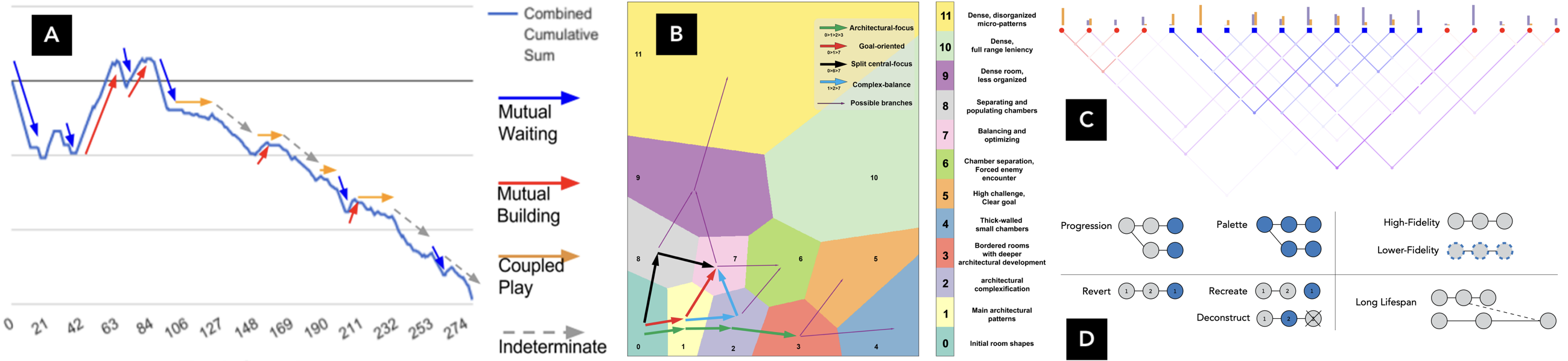 Prior analyses of creative activity traces, including a creative sensemaking curve (A); a visualization of trajectories through a design space (B); a fuzzy linkograph (C); and an analysis of version control commit histories (D).
Herding CATs: Making Sense of Creative Activity Traces is a CHI 2026 workshop that aims to advance the analysis of creative activity traces, including (but not limited to!) those captured through user interaction with software creativity support tools (CSTs). Traces of creative activity constitute a rich resource for identifying the impacts of CSTs—especially AI-based CSTs—on the creative process, and may also inform general-purpose process theories of creativity. Several new approaches to making sense of these traces have been introduced in the past few years, but many of these approaches have emerged from largely disjoint research communities, hindering the development of a shared analytical toolkit. We propose to gather HCI and creativity researchers, including proponents of several different trace analysis techniques, to sketch out a technique design space to guide future empirically grounded research on creativity support.
For a comprehensive overview of the workshop's goals and scope, see the full workshop proposal in the ACM Digital Library.
Participation
Participation in the workshop is open to both experienced and emerging creativity researchers, including core HCI researchers, those in relevant AI subfields (e.g., computational creativity and game AI) and creative scholar-practitioners. To attend, participants must submit a position paper of 2-4 pages in single-column ACM format (excluding references). Papers should describe a research question, direction, argument, or proposal related to creative activity traces.
Position papers should be submitted via our Google form.
Participants are encouraged to upload their accepted position papers to arXiv. Accepted submissions will also be made available via the workshop website. At least one author per accepted submission must attend the workshop in person.
For accessibility requirements, please contact access@chi2026.acm.org and note your needs on the conference registration form.
Timeline
- Position Paper Deadline:
February 12, 2026February 20, 2026 (extended) - Notification to Authors: February 24, 2026
- CHI Early Registration Ends: March 4, 2026
- Workshop Date: April 15, 2026
Organizers
- Max Kreminski, Cornell Tech
- Amy Smith, Queen Mary University of London
- John Joon Young Chung, Midjourney
- Kihoon Son, KAIST
- Qian Yang, Cornell University
- Sang Won Lee, Virginia Tech
- Noor Hammad, Carnegie Mellon University
- Eric Rawn, University of California, Berkeley
- Shm Garanganao Almeda, University of California, Berkeley
- J.D. Zamfirescu-Pereira, University of California, Los Angeles
Accepted Papers
- Human-AI Interaction Traces as Blackout Poetry: Reframing AI-Supported Writing as Found-Text Creativity
Syemin Park, Soobin Park, Youn-Kyung Lim - What Happened and Why? Trace-Guided Micro-Episodes with Elicited User Explanations for Product Iteration
Sirui Tao, William P. McCarthy, Steven P. Dow - Beyond Semantic Similarity: Open Challenges for Embedding-Based Creative Process Analysis Across AI Design Tools
Seung Won Lee, Semin Jin, Kyung Hoon Hyun - Reassessing the value of creative activity traces for understanding and supporting creative work
Matthew Klenk, Shabnam Hakimi, Matthew Hong, Pablo Paredes, Yan-Ying Chen - Tracing Semantic Provenance: Multimodal Fuzzy Linkography for Long-Term AI-Assisted Visual Ideation
Wen-Fan Wang, Yi-Ting Chiu, Max Kreminski - On the Importance of Tool Selection in the Creative Process: Figure Drawing as a Research Site
Miranda Li, Ziv Epstein, Cynthia Breazeal - Structurally Capturing the Reasoning Moves in AI-enabled Creativity Support Tool
Yaqing Yang, Vikram Mohanty, David Chuan-En Lin, Yan-Ying Chen, Matthew K. Hong, Nikolas Martelaro, Aniket Kittur - From Logs to Agents: Reconstructing High-Level Creative Workflows from Low-Level Raw System Traces
Tae Hee Jo, Kyung Hoon Hyun - Exploring Activity Traces from Live Coding Musicians
Daniel Manesh - Trace-Aware Workflows for Co-Creating Branded Content with Generative AI
Taehyun Yang, Eunhye Kim, Zhongzheng Xu, Fumeng Yang - DrawTalking It Out: Creativity-Support Research as Creative Process Itself
Karl Toby Rosenberg - Tracking Creativity Traces in Game Jams and Hackathons
Jeanette Falk, Yiyi Chen - Tracing the Unwritten: Toward Sensemaking-Aware Analysis of Creative Activity Traces in Narrative Writing
Judith Kankam-Boateng - Seams as Trace Infrastructure: How Tool Architecture Shapes What Creative Activity Traces Can Capture
Deanna Gelosi - Toward Machine-Interpretable Spatial Organization Patterns: Learning from Creativity Traces
Maryam Rezaie, Sheelagh Carpendale - InfiniteCATs: Semantic Crafting as a Substrate for Creative Activity Tracing
Nicholas Jennings, Shm Garanganao Almeda, Sam Poder, Björn Hartmann - Making Sense of (My) Traces: Practitioner and Researcher Perspectives on Trace Data
Sarah Sterman - Bridging Workspace Awareness and Creative Activity Traces: Toward a Taxonomy of Real-Time Trace Visualization Idioms
Jeb Thomas-Mitchell, Leping Qiu, Fanny Chevalier - Creative Activity Traces in Coding: A Proposed Methodology to Study Creativity of Novice Programmers Using GenAI
Vittoria Frau, Samangi Wadinambiarachchi, Jonas Frich - State of the Art(tist): Towards an Artistic User Model in Creative Activity Traces
Grace Wang, Nicholas Jennings - Towards Linkographs for Reflective Revisitation
Raina Cao - Data Physicalization as Care: Expanding What Gets Traced Through Considering Materiality
Izabella Rodrigues, Jane L. E - Co-herding CATs: Participatory Living Lab for CATs Analysis
Unnati Pradhan, Sharon Ferguson, Jens Emil Grønbæk - How Structure Mediates Creative Activity Traces
Vincent Cavez - Tracing Non-Dyadic Creative AI Interaction
Carey Linda Crooks - Process as Poetic Provenance
Alicia Guo - Reflections on making a Creative Activity Trace tool for Digital Artists
Angela Bi, Thijs Roumen - TRAX: Bridging the Gap in Asynchronous Music Collaboration
Jaywoong Jeong, Dongwoo Kim, Jaehong Jung, Dohyun Ko, Jiwon Eom, Sangmin Lim, Juchan Lee - Tracing Recombinational Creativity: A Multi-Level Framework for Measuring Novelty in Creative Processes
Yulin Yu - From State Changes to Creative Decisions: Documenting and Interpreting Traces Across Creative Domains
Xiaohan Peng, Sotiris Piliouras, Carl Abou Saada Nujaim - Chasing RATs: Tracing Reading for and as Creative Activity
Sophia Liu, Shm Garanganao Almeda - Multimodal Activity Traces for Creative Repurposing
Kexue Fu, Jingfei Huang, Long Ling, Toby Jia-Jun Li, RAY LC